
DISC Personality Assessment
Quick, Accurate Test Shows Your Team Personality and Work Style
This DISC assessment will help you discover your personality at work. Discover the four DISC personality types and improve communication, productivity, and conflict management in the workplace. Take the DISC test yourself, or use it with your team.
To take the DISC assessment, mark each word below according to how well it describes you.
As Seen In
What is the DISC personality test?
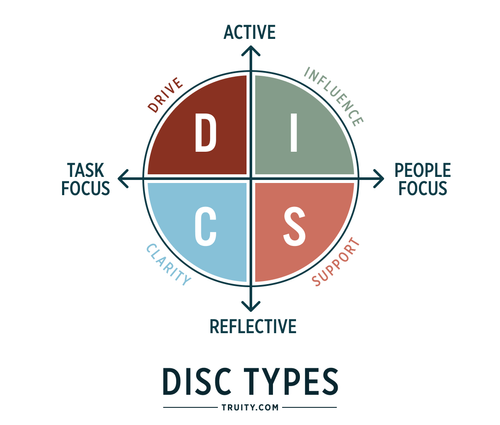
The DISC measures one’s predominant work style, as described as one of four types: Drive, Influence, Support, and Clarity. The DISC is one of the most popular personality assessments used in corporate and organizational settings and can help employees find their strengths, improve team function, and enhance communication and productivity.
Because there are only four types in the DISC system, it is easy to learn. Yet, despite its simplicity, the DISC personality assessment describes some of the most fundamental differences between individuals so it is very powerful in terms of understanding why people do what they do — and then using this knowledge to reduce conflict and improve working relationships.
When you know your DISC type, you can learn more about what motivates you, how you respond in different work situations, and how you interact with others. The assessment gives context to behaviors that, at first glance, may seem confusing, unfamiliar or even contradictory.
Unlike other personality frameworks which are designed to help people become more self-aware in all areas of life — relationships, careers, personal development and so on — the DISC personality test is focused on behavior at work. Assessments are frequently used in workplace settings to help teammates better understand one another and how to work together.
The DISC Personality Types
DISC results show where a person falls along two axes of behavior: Active vs. Receptive and Skeptical vs. Agreeable. Taken together, these two axes form a grid, where each quadrant represents one of the four DISC personality types.

A person's preference on both axes determines their DISC letter code. No DISC style is ‘better’ or ‘worse’ than any other. They are just different, and each style brings its own strengths and value to the workplace. DISC simply helps us find out which style we tend to gravitate towards the most.
There are four basic personality types in DISC:
- Drive. Drive relates to control, power and assertiveness. People who are high in Drive like to get things done and are results-oriented. They tend to be ambitious, competitive and persuasive. If you have a lot of Drive, you're likely to enjoy taking on new challenges and being in charge.
- Influence. Influence relates to people, interaction and communication. People who are high in Influence are interested in relationships, networking and persuasion. If you have a lot of Influence, you're likely to enjoy social situations and working with people.
- Support. Support relates to patience, thoughtfulness and harmony. People who are high in Support are warm and accepting of others, and they like structure and organization. If you have a lot of Support, you're likely to enjoy working hard behind the scenes and being part of a team.
- Clarity. Clarity relates to structure, organization and correctness. People who are high in Clarity are detail-oriented, quality-conscious and cautious when making decisions and taking action. If you have a lot of Clarity, you're likely to enjoy working intentionally to solve challenging problems.
Many people don't fit perfectly into just one of the four DISC personality types. In fact, for most people, either one or two predominant personality styles stand out. This gives us 12 common combinations: four pure types, which are designated with the letters D, I, S, and C, and eight combination types which are notated with codes like Di, Cd, and Is, where the second, lowercase letter indicates a type that has an additional influence over an individual’s behavior. Truity’s DISC report provides one’s primary DISC style as well as secondary styles of Influence.
Is the DISC a valid, reliable personality test?
DISC has been around for a century, is used by almost three-quarters of Fortune 500 companies, and is the go-to tool of global organizations for team building, communication training and project management. Various studies of DISC assessment validity and reliability have shown it is on par with other industry-standard psychometric assessments, indicating that it can be effectively used in professional settings.
The father of DISC was American psychologist William Moulton Marston, who is also credited with inventing the polygraph test. In the 1920s, Marston used his knowledge of physiology and psychology to develop a model of human behavior that he called DISC.
Fast-forward to the 21st century, and DISC theory has been incorporated into a huge number of personality assessments, for instance, the Everything DiSC® published by Wiley and Truity's own DISC assessment.
While many companies have developed tests based on the DISC theory, standards may vary wildly from test to test. Some tests, like Truity’s free DISC assessment, have been thoroughly researched and developed by psychometrics professionals. In general, purchasing a DISC assessment from a respected publisher means the assessment has been studied, often over many years, to ensure it provides accurate results.
DISC Assessment FAQ
Q. What does the DISC assessment measure?
A. The DISC assessment is a measure of interpersonal behavior that is often used in workplace settings. It classifies how we interact in terms of four personality styles: Drive, Influence, Support, and Clarity.
Based on the theories of psychologist William Moulton Marston, the DISC assessment is a simple yet powerful way to unlock your strengths and help your team work better together.
Q. What are the four DISC personality types?
The DISC personality model describes four types: D for Drive, I for Influence, S for Support, and C for Clarity. Each type describes a particular approach to getting work done and contributing to a team.
- Drive: taking charge and making key decisions
- Influence: engaging others to work together
- Support: assisting others to achieve group goals
- Clarity: working independently to produce correct results
Each of the four DISC personality types is equally valuable, and each has its own strengths and weaknesses. Discovering your own type can help you to better understand how to bring your strongest talents to your work, while minimizing your blind spots.
Q. What are DISC subtypes?
A. DISC subtypes represent a blend of two styles. Each of us has a primary DISC type, but some of us also incorporate quite a bit of an adjacent style into our behavior at work. These styles are referred to as DISC subtypes or hybrid types. For example, a person who is primarily a Drive type, but who also has a high level of Influence behavior, would be labeled as a D/i type (DISC + Influence).
When we include the subtypes with the four primary DISC types, we are able to accurately describe people whose behavior is primarily driven by one DISC style, as well as people whose behavior is typically a mix of two styles.
The eight DISC subtypes are:
- D/i (Drive + Influence)
- D/c (Drive + Clarity)
- I/d (Influence + Drive)
- I/s (Influence + Support)
- S/i (Support + Influence)
- S/c (Support + Clarity)
- C/s (Clarity + Support)
- C/d (Clarity + Drive)
Q. What will I learn from my DISC report?
A. Your DISC profile will show which of the four DISC types fits you best, as well as your scores for the other three types. It will describe how the DISC model can be used to better understand your strengths on a team, as well as the way you like to work.
When completing the Truity DISC assessment, you will first see a brief, free report showing a basic overview of your DISC personality type. Then, you have the option of unlocking your full report for a small fee. To see what you can expect from a comprehensive report, here is a sample DISC report.
Q. Can I have my employees, team or group take the DISC test?
A. Absolutely. Our Truity @Work platform is designed to make it easy to give the DISC assessment to your team or group. See discounted group pricing and learn how to quickly and easily set up testing for your group on the Testing for Business page.
Q. How long is this DISC assessment?
A. The test consists of 38 questions and takes about 5 minutes to complete.
Q. Is this DISC assessment scientifically validated?
A. This inventory has been researched thoroughly to ensure it is valid and reliable.
Q. Is the DISC personality test really free?
A. You do not need to purchase or register to take this test and view an overview of your results. If you would like, you can purchase a more comprehensive full report for a small fee.
Q. Do I need to complete this assessment all at once?
A. If you’ve created an account and are logged in when you take the test, your responses will be saved as you go through the test. If you do not log in to a Truity account before starting the test, your progress will not be saved and you will need to complete the test all at once.
Q. How can I access my test results?
A. After you take a test, you will have the option to create an account by entering your email address. If you create an account, you can view your test results at any time by returning to Truity.com and logging into your account. We do not email your results to you.
Q. Is the DISC personality test appropriate for children?
A. None of our tests are appropriate for children under the age of 14. Some of our tests may have mature content, and anyone younger than 18 should only take the test with parental guidance.
Q. Are you going to sell my data?
A. . We do not sell your email or other personal data to any third parties, and we have a zero-spam policy. We carefully comply with applicable privacy laws in handling your personal information. You can read more in our privacy policy.